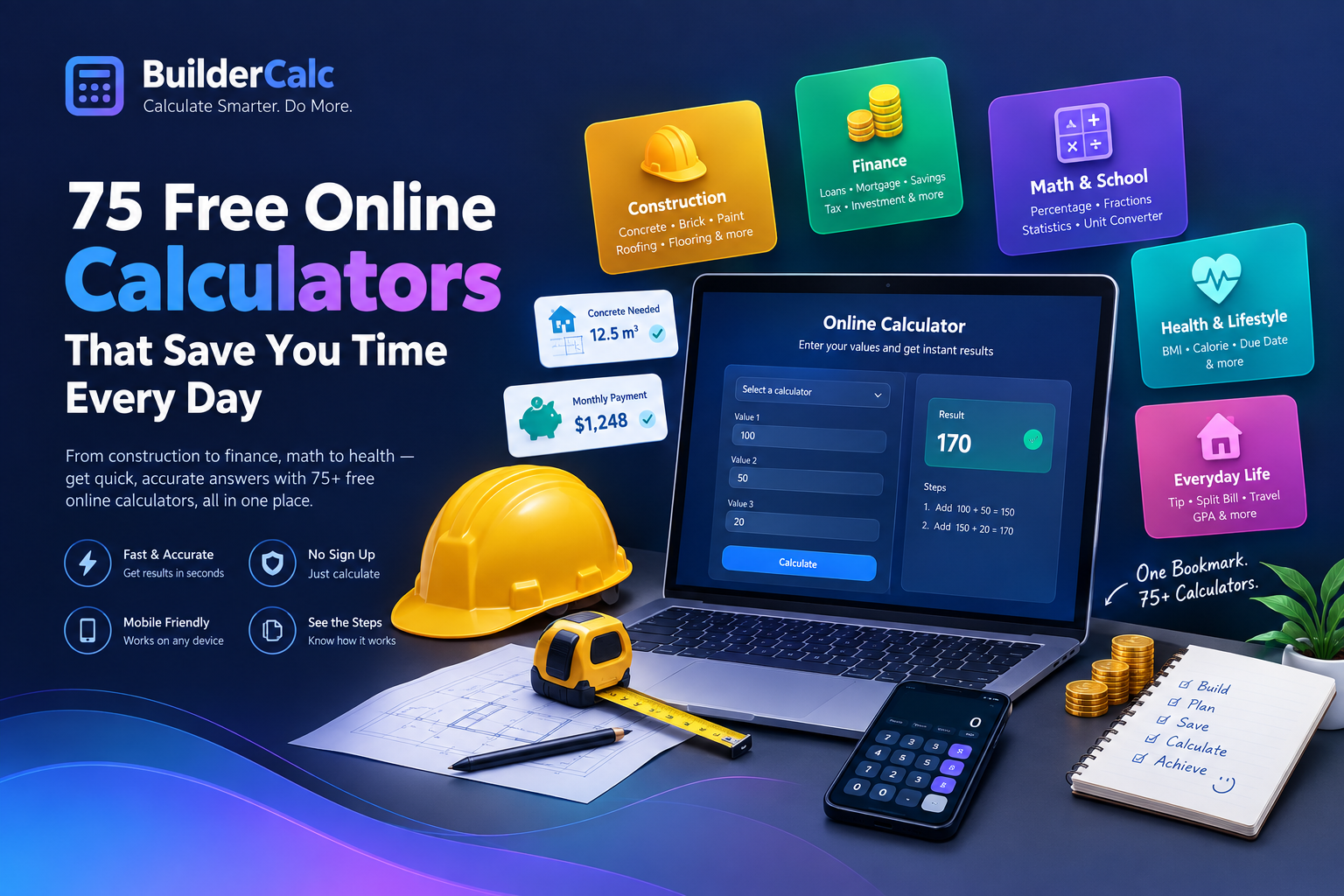
75 Free Online Calculators That Save You Time Every Day
Most of us do the same small calculations over and over: how much concrete for that slab, what a loan really costs per month, how many tiles the bathroom needs, whether two job offers actually differ after tax. Each one takes five minutes with a phone calculator — and each one is a chance to get it wrong.
That is the quiet appeal of a good online calculator collection. Instead of rebuilding the same formula every time, you bookmark one page, type in three numbers, and get a trustworthy answer in seconds. Keeping a short list of reliable free online calculators handy saves more time over a year than most people expect — here is a tour of what 75 of them can do, organized the way you would actually use them.
Construction and DIY: Measure Once, Order Right
This is where calculators earn their keep fastest, because material mistakes cost real money. A concrete calculator turns slab dimensions into cubic yards (plus the waste factor you should never skip). A brick calculator converts wall measurements into brick counts with mortar joints included. Paint, tile, roofing, lumber, flooring, drywall, insulation, fencing, decking — every one of these has the same shape of problem: measure an area, apply a coverage rate, add waste, convert to purchase units. Doing it by hand once is educational; doing it by hand on every project is just slow.
The less obvious wins are the planning calculators: roof pitch, stair rise-and-run, concrete block and rebar counts, or how much gravel a driveway needs. These answer questions that otherwise require a phone call to a supplier or a half-remembered formula from a forum.
Money and Finance: See the Real Numbers
Finance calculators do something a spreadsheet often does not: they show you the answer before you have talked yourself into the purchase. Loan and mortgage calculators reveal what a monthly payment really looks like over the full term — and how much of it is interest. Compound-interest calculators make the abstract idea of "start saving early" concrete in a way advice never does.
Then there are the everyday money questions: splitting costs fairly, calculating discounts and sales tax, figuring out a tip, or comparing two salaries with different tax situations. None of these are hard; all of them are annoying. A calculator removes the annoyance, which means you actually run the numbers instead of guessing.
Math, School, and Work: Homework to Engineering
Students and professionals share the same need: a quick, correct answer to a standard problem. Percentage calculators, fraction converters, unit converters, and scientific functions cover the daily school workload. Statistics helpers — mean, median, standard deviation — turn a column of data into insight without opening a spreadsheet.
For technical work, the value is verification. Engineers and technicians use calculators to double-check a result computed elsewhere; a second, independent computation catches the typo-class errors that cause real problems. Even a simple age-difference or date-duration calculator settles the "how long exactly?" questions that come up in contracts, HR, and planning.
Everyday Life: The Small Questions
Some calculators exist for questions you did not know you had until you needed the answer: how much paint is left in a half-used can, what time you will arrive if you leave at a certain hour, how to split a restaurant bill with different orders, or what your GPA works out to this semester. Individually trivial; collectively, the kind of friction that eats an afternoon.
Health and lifestyle calculators belong here too — BMI, calorie needs, pregnancy due dates — the personal-math questions people quietly search for every day.
How to Choose Calculators Worth Bookmarking
Not every calculator site deserves your trust. A few things to look for:
- It shows its work. The best calculators explain the formula or the steps, so you can sanity-check the answer instead of taking it on faith.
- Units are handled properly. A calculator that silently mixes feet and meters will betray you. Good ones label every input.
- No account required. A quick calculation should not cost you an email address. If a site demands sign-up before showing a result, find another one.
- It works on your phone. Most real-world calculating happens on a job site, in a store aisle, or at a kitchen table — not at a desk. A calculator that is unreadable on a small screen is not much use where you need it.
- Results are copy-friendly. The good ones let you copy or print the result, which matters when the number has to go into a quote, an email, or a shopping list.
One Bookmark Instead of Seventy-Five
The practical move is simple: instead of searching for a new calculator every time a question comes up, bookmark one comprehensive collection and learn where things live in it. The first few times you will still search; after that, muscle memory takes over and the answers come faster than opening a spreadsheet or re-deriving a formula. The minutes saved per question are small; the number of questions per year is large. And the mistakes avoided — the short concrete order, the underpriced bid, the misunderstood loan — are worth far more than the time.
Daniel Carter is a construction and DIY writer at BuilderCalc (buildercalc.online), a free library of 75+ online calculators covering construction, finance, math, and everyday calculations.